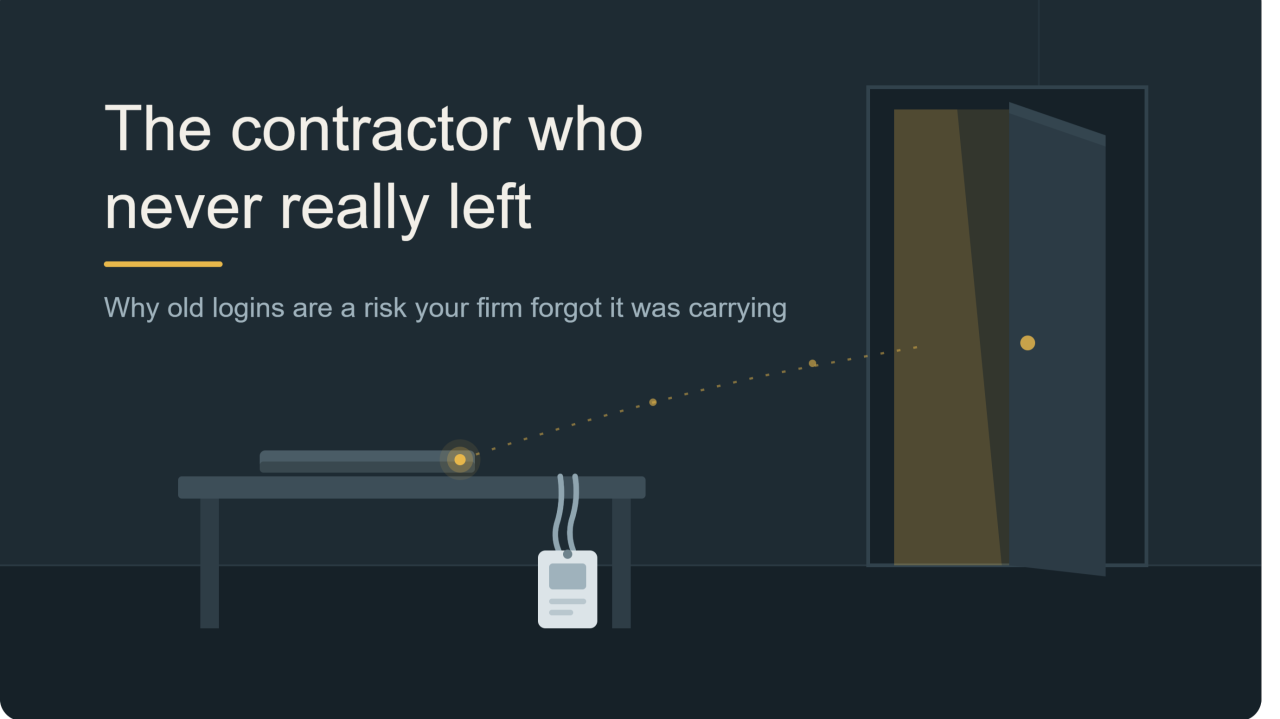
Priya ran a small marketing agency in Clerkenwell, twelve people, good clients, the kind of place that punched above its size. Back in the spring, she'd brought in a freelance designer for a three month campaign push. Sharp, reliable, easy to work with. When the contract ended, she thanked him, paid the final invoice, and moved on. Nobody thought to check what he could still access.
Three months later, a client called to ask why a competitor seemed to know the exact messaging they hadn't launched yet. Priya's stomach dropped before she'd even started investigating. When she did, she found the freelancer's login to the shared drive was still live. So was his access to two client social accounts. Nobody had switched anything off. He probably hadn't done anything with it at all. But she had no way of knowing that, and neither did her client.
This is one of the quieter risks in small business operations, and it rarely gets talked about because it doesn't look like an emergency. It's simply what happens when access outlives the relationship that justified it. Someone joins, gets set up with the logins and permissions they need to do their job, and then leaves, whether that's an employee, a freelancer, or a supplier. The process for switching that access off either doesn't exist or depends on someone remembering to do it manually. In a five person team that's forgivable. In a growing firm juggling multiple contractors, client systems, and shared platforms, it becomes a gap that widens every time someone new comes and goes.
The practical implication isn't hypothetical drama. It's much more mundane, and in some ways more uncomfortable. It's a former team member who still has a password to your accounting software eighteen months after they left. It's an old supplier's login sitting dormant in your customer database. It's a contractor who, with no ill intent at all, still gets a notification every time a shared file changes, because nobody removed them from the group. None of this requires anyone to do anything wrong for it to become a problem. A lost device, a moment of carelessness, a simple mistake, and access that should have ended months ago becomes the route through which something goes wrong. When a client asks who could have seen their data, "we're not entirely sure" is not an answer that inspires confidence.
The firms that handle this well don't rely on memory. They treat the end of any working relationship as a proper process rather than an afterthought, a clear checklist triggered the moment someone's involvement with the business ends, covering every system they touched, not just the obvious ones like email. It also means knowing, at any given moment, exactly who has access to what, rather than discovering the answer only when something has already gone wrong. That visibility is the part most small firms lack, not because they're careless, but because nobody's job is specifically to maintain it. Systems get set up in a hurry and then they just run, until they don't.
This is precisely the kind of gap that ongoing monitoring is built to catch. Watching continuously for exactly this sort of loose end, accounts that should have been closed, permissions that no longer match who's actually on the team, is different from someone being on standby to react at midnight. Monitoring never switches off. Response happens within agreed hours. For a firm like Priya's, the value isn't drama free heroics, it's simply having someone whose job it is to notice what her own team, understandably, didn't have time to.
NOCTeam works with small professional services firms precisely because these gaps tend to form quietly in businesses that are too busy running well to audit their own back office. An IT Health Check is a straightforward way to see exactly where those gaps might be sitting in your own systems, no obligation, no jargon, just a clear picture of who can access what and what that means for your business.
If you'd like that clarity for your own firm, you can book a free IT Health Check at nocteam.co.uk or email us on [email protected].
Originally published on LinkedIn.