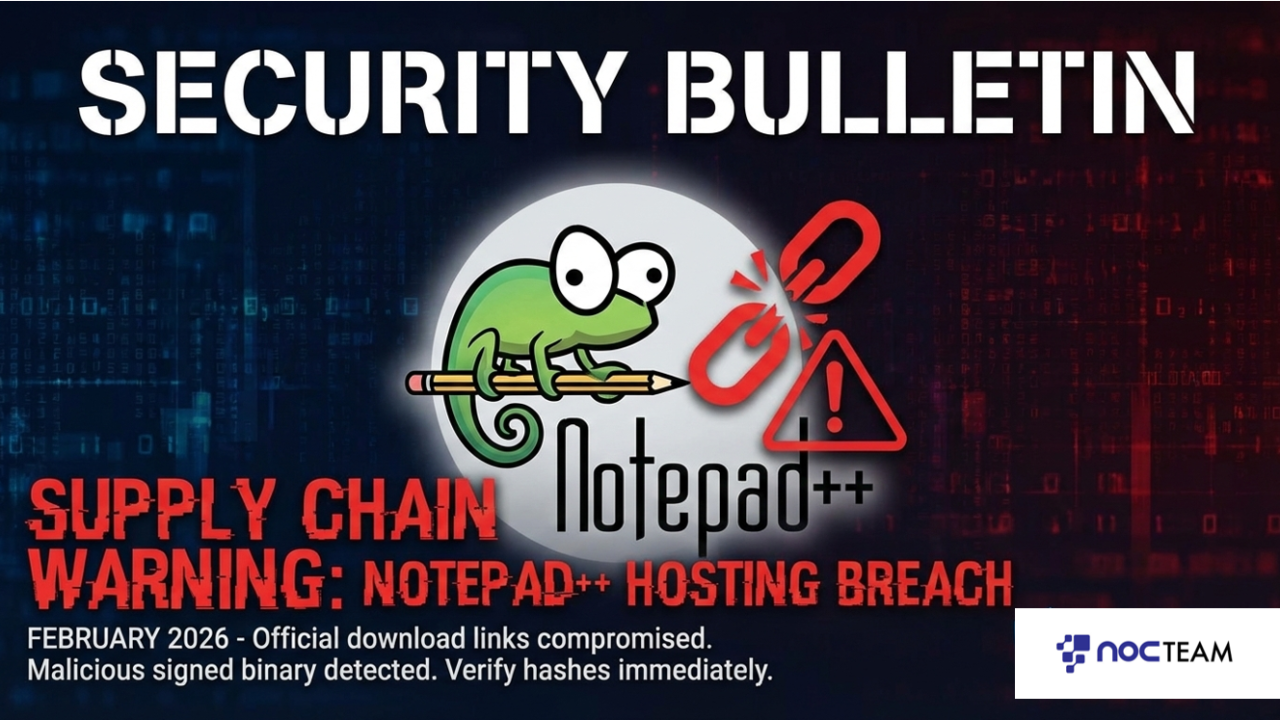
It is the one tool found on almost every IT professional’s desktop. But this week, Notepad++ became the "Trojan Horse" of the dev world. The compromise of its hosting infrastructure isn't just another supply chain attack; it’s a targeted strike on the people who hold the keys to the kingdom.
What Happened? Earlier this week, the official hosting infrastructure for Notepad++ was compromised. For a critical 6-hour window, the legitimate download links were redirected to a mirrored server hosting a digitally signed, but malicious, version of the installer.
This wasn't a "cloned" fake site; it was the official site pointing to a poisoned source. The payload? A sophisticated Infostealer designed specifically to harvest SSH keys, AWS tokens, and browser-saved credentials.
Why This Attack is "High-Yield" for Hackers Attackers aren't just looking for random data anymore; they are looking for Access. By targeting Notepad++, they aren't hitting the average consumer, they are hitting,
- Developers - Access to source code and GitHub repos.
- Sysadmins - Access to servers and cloud infrastructure.
- Security Pros - Access to the very tools used to defend the network.
When an IT pro downloads a tool they’ve trusted for 20 years, their guard is down. That "implicit trust" is exactly what 2026 threat actors are weaponizing.
The "Silent" Red Flag The most chilling part of this breach? The malicious binary was digitally signed with a stolen but valid certificate. This meant that standard Windows "SmartScreen" and many basic antivirus tools didn't blink. It looked legitimate because, on a structural level, it was legitimate.
3 Actionable Lessons for 2026 Stop "Blind" Downloads, even for trusted tools, your team should be verifying SHA-256 hashes provided on official documentation (though in this case, even the documentation was compromised, highlighting the need for "out-of-band" verification).
- Isolate the Dev Environment - Developers often require "Local Admin" rights to work. This makes them a high-value target. 2026 requires Privileged Access Management (PAM), even for your most trusted senior engineers.
- Monitor the "Tooling" Behavior - Your EDR (Endpoint Detection and Response) shouldn't just look for "bad files." it should be asking - "Why is Notepad++ suddenly trying to read the .ssh folder and then making an outbound connection to an unknown IP in Eastern Europe?"
- Protecting the Protectors At NOCTeam, we know that IT professionals are the most targeted users in any organization. We specialize in securing the "Inner Circle" by implementing advanced EDR policies and zero-trust architectures that don't rely on implicit trust.
Is your team’s toolkit a hidden liability? Let’s talk about securing your developer and admin workflows.
Contact us at [email protected].
Originally published on LinkedIn.