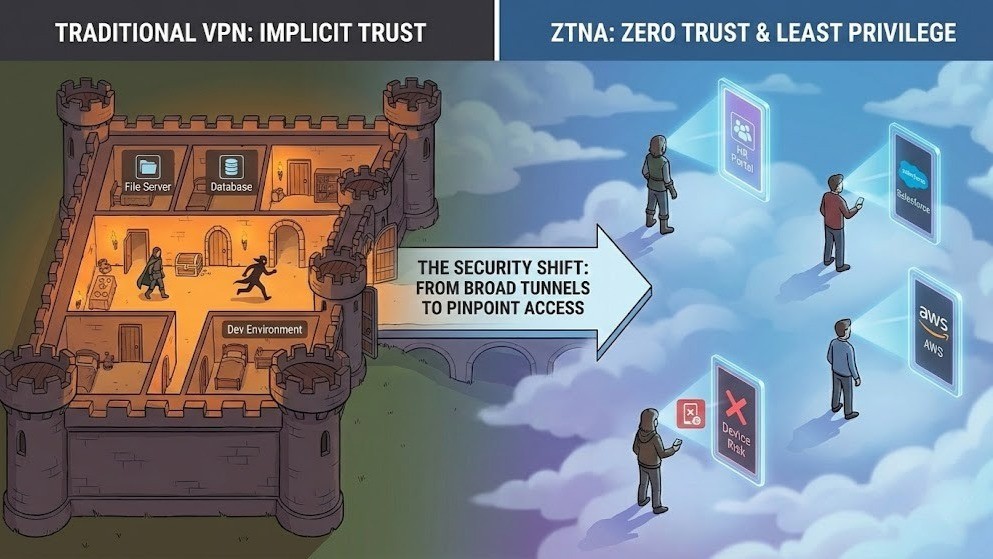
For decades, the Virtual Private Network (VPN) was the undisputed champion of secure remote access. By creating an encrypted tunnel between a remote user and the corporate network, the VPN effectively treated a user logging in from home as if they were sitting in the office.
However, in today's cloud-first, hybrid work environment, the VPN's fundamental security philosophy—trusting the user once they are "inside" the perimeter—has become its biggest vulnerability.
Enter Zero Trust Network Access (ZTNA). ZTNA is the modern, highly granular approach to secure access that operates on one core principle - "Never trust, always verify."
Here is how ZTNA differs from traditional VPNs and why this distinction is critical for business leaders and IT management today.
The Fundamental Flaw of the VPN - Implicit Trust
A traditional VPN works like a secret door into a private castle. Once a user authenticates at the perimeter gateway, the door is opened, and they are granted broad access to the internal network.
- Broad Access - If a user only needs one specific application (e.g., the HR portal), the VPN still connects them to the entire network (including file servers, databases, and development environments) for which they may not have application-level permissions.
- Lateral Movement Risk - If a criminal steals a user's VPN credentials (a common phishing goal), the attacker immediately gains a foothold inside the network. They can then perform "lateral movement," probing and exploring until they find sensitive data, dramatically increasing the "blast radius" of the breach.
- Built for On-Premise - VPNs route all traffic through a central gateway, causing performance bottlenecks and high latency, especially when accessing applications hosted in the cloud (like Microsoft 365).
ZTNA - The Philosophy of "Least Privilege"
ZTNA represents the technological implementation of the Zero Trust security model. Instead of connecting the user to the network, ZTNA connects the user only to the specific application they require, based on their verified identity and the health of their device.
The core differences between the two models are substantial,
- Trust Model - Traditional VPNs rely on implicit trust—the user is trusted once they are inside the network. ZTNA operates on Zero Trust, requiring continuous verification for every access request.
- Access Scope - A VPN grants broad access to the entire private network, while ZTNA grants highly granular access only to the specific applications or services required by the user, adhering to the principle of Least Privilege.
- Network Visibility - VPNs leave the internal network visible to the authenticated user. ZTNA effectively makes applications hidden from unauthorized users, creating a "Dark Cloud" that prevents attackers from seeing the network topology.
- Verification - A VPN relies on a single authentication check at the gateway. ZTNA implements continuous verification, checking the user's identity, device health, location, and context per session.
- Architecture - VPNs rely on centralized hardware gateways, which lead to bottlenecks, while ZTNA uses a cloud-native, distributed service that is highly scalable and improves performance for cloud-based applications.
The Security and Business Benefits of ZTNA
ZTNA is quickly becoming the standard for modern enterprises because it solves the core challenges posed by hybrid work and cloud adoption -
- Minimised Attack Surface
By hiding the internal network and granting access only to a single application, ZTNA eliminates the primary threat of lateral movement. If an attacker compromises one user's credentials, they can only access that single, authorized application, severely limiting the damage they can inflict.
- Device Posture Checking
ZTNA doesn't just check who you are; it checks what you are using. If a device is missing the latest operating system patches, has disabled antivirus, or is connecting from a suspicious geographic location, ZTNA can automatically deny access, regardless of the user's password.
- Superior User Experience and Scalability
Since ZTNA is cloud-native, it removes the performance degradation associated with routing all traffic back to a centralized VPN concentrator. Users connect directly, securely, and seamlessly to the applications they need, resulting in faster performance and simpler management for IT teams.
Time to Retire the VPN - How NOCTeam Can Help
While VPNs served a vital purpose for decades, they are ill-suited for the complex, distributed environment of today. Implementing ZTNA is not just a technical upgrade; it is a fundamental shift in your security architecture that aligns with modern compliance and risk management mandates.
NOCTeam are experts in designing and deploying Zero Trust solutions tailored to your infrastructure (whether hybrid, cloud-only, or multi-cloud).
- ZTNA Readiness Assessment - We evaluate your current network, data flow, and identity management to map out a clear transition path from VPN to a Zero Trust architecture.
- Identity and Access Policy Design - We set up granular, context-aware access policies (Who? What? Where? When?) that ensure the Principle of Least Privilege is consistently enforced across all applications.
- Managed ZTNA Deployment - We manage the seamless implementation of your ZTNA solution, integrate it with your existing identity providers (IdP), and provide continuous monitoring to maintain compliance and security.
Ready to stop trusting and start verifying? Contact NOCTeam today at [email protected] to secure your remote workforce with a future-proof ZTNA solution.
Originally published on LinkedIn.