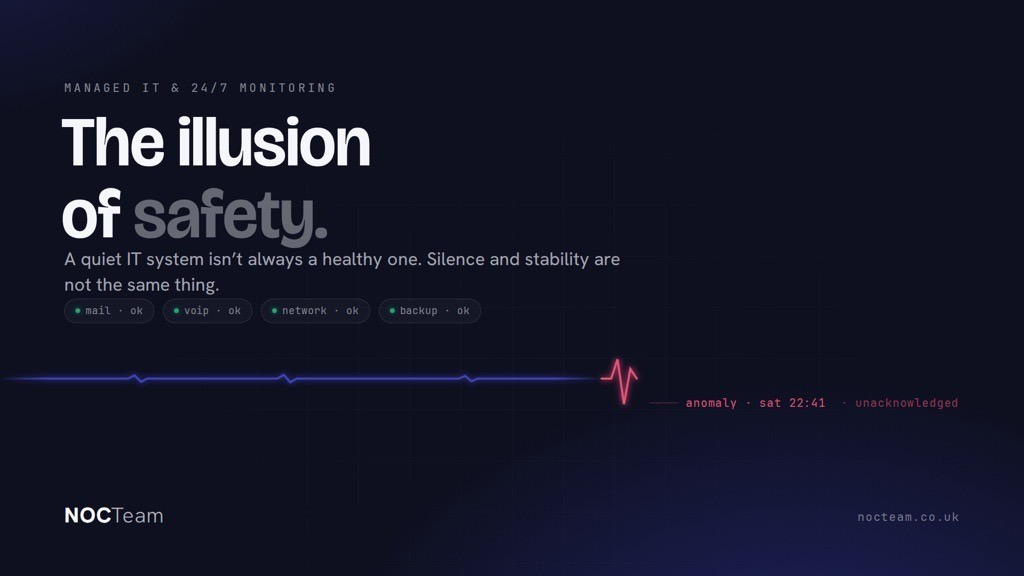
Sarah, the managing director of a London-based property consultancy, arrives at her office on a rainy Monday morning feeling entirely confident about the week ahead. Her team is scheduled to exchange contracts on a significant commercial acquisition by mid-day, a deal that has been months in the making. She sits down with her coffee, logs into her laptop, and attempts to open the shared project folder containing the final, signed legal deeds. Instead of the familiar list of documents, she is greeted by a blank screen and a spinning icon that refuses to clear. She calls out to her operations manager, only to find that every person in the office is experiencing the exact same digital paralysis. The central storage system had quietly stalled sometime on Saturday evening due to a corrupted automated update, leaving the entire business completely stranded at the exact moment their largest client required immediate action.
This frustrating scenario represents the classic illusion of quiet technology. For many leaders of professional services firms, no news from the IT department is generally considered good news. If the phones are ringing, the emails are sending, and no one is actively complaining, the assumption is that everything is functioning exactly as it should. This reactive mindset treats technology like a household appliance that only requires attention when it completely breaks down. In reality, a silent network is not necessarily a healthy network. Serious infrastructure issues rarely announce themselves with a sudden crash. They begin as small, unnoticed errors, such as a failing hard drive, a stalled security patch, or a backup routine that quietly stops copying data to the cloud while reporting a false status.
The practical implication for a small business is rarely a dramatic cinematic emergency, but rather a slow and painful drain on operational momentum. When a system fails silently over a weekend, the true cost is measured in lost billable hours, fractured client trust, and missed deadlines that cannot be recovered. For a law firm or an HR consultancy, a morning spent staring at broken screens while waiting for an engineer to arrive means contracts are delayed and time-sensitive client queries go unanswered. Your clients do not see a technical glitch; they see an unreliable partner who cannot deliver when the stakes are high. Relying on a traditional model where you only call for help after the disaster has occurred means you are constantly paying to fix damage that could have been entirely prevented.
A sophisticated approach to business technology requires moving away from fixing what is broken and moving toward continuous oversight. This means having an invisible guardian that watches your digital infrastructure every hour of every day, identifying anomalies before they manifest as operational paralysis. It is vital to understand that continuous tracking is entirely distinct from immediate emergency deployment. True monitoring happens constantly in the background, identifying a failing component or a frozen update in the middle of the night so it can be resolved calmly within agreed business hours before your staff even log in for the day. This proactive stance ensures that your team encounters a stable, predictable working environment every single morning.
This level of operational resilience is precisely what NOCTeam provides for growing professional services firms. By maintaining a constant watch over your entire network infrastructure, the engineers at NOCTeam catch the early warning signs of system distress long before they can impact your clients or your reputation. Instead of reacting to an unexpected crisis on a crucial Monday morning, you gain the peace of mind that comes from knowing your systems are being actively looked after by specialists who value your business continuity as much as you do. To discover where your business might be vulnerable to these silent operational disruptions, take a proactive step and book a free IT Health Check by visiting us at Nocteam.co.uk or by emailing us at [email protected]
#ITSecurity #BusinessContinuity #ManagedITServices #NOCMonitoring #LondonBusiness
Originally published on LinkedIn.