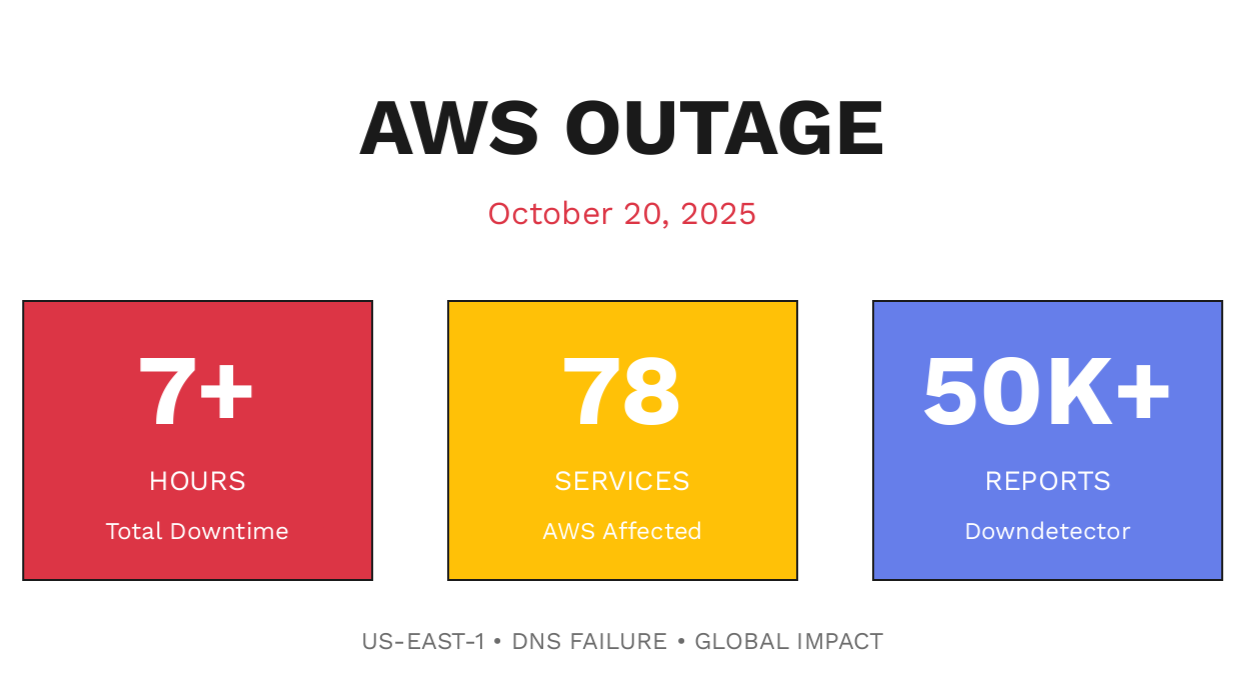
The recent AWS outage in the crucial US-EAST-1 region, which crippled hundreds of applications and services globally, has once again highlighted a profound truth in network engineering , it's always DNS. This incident serves as a reminder for every technologist and business leader of the Domain Name System's (DNS) fundamental importance in modern cloud architecture.
What Happened - A Cascade Rooted in DNS
AWS’s post-incident analysis revealed the root cause was a latent software defect within the highly automated system managing the Domain Name System (DNS) records for their core database service, DynamoDB.
- The Problematic Component - DNS Automation DynamoDB endpoints, like virtually all cloud services, rely on DNS to translate their human-readable name into the specific IP addresses needed for client traffic routing. This process is managed by sophisticated internal automation.
- The Root Cause: The "Race Condition" The failure stemmed from a subtle race condition—a flaw where the outcome of a process depends critically on the sequence or timing of uncontrollable events. In this case, two concurrent internal automation components—a Planner (which calculates DNS changes) and an Enactor (which implements them)—came into conflict. Due to this timing clash, the automation system unexpectedly initiated a command to delete all valid IP addresses for the DynamoDB service endpoint in the crucial US-EAST-1 region.
- The Cascade - Service Disconnect With its DNS records deleted, the DynamoDB service became undiscoverable via network lookups, even though the underlying database servers were operational. Crucially, many other fundamental AWS services—including EC2 instance management and internal Network Load Balancer (NLB) state checks—are internally dependent on DynamoDB. When these dependent services could no longer resolve DynamoDB’s address, their operations failed, triggering a widespread cascading outage across the region.
In essence, a small, complex timing bug in the system that manages the service's addressing led to a massive disconnect in the entire infrastructure.
Why DNS is the Unsung Hero (and Single Point of Failure)
The incident underscores why DNS isn't just "background plumbing"—it's the critical infrastructure layer that underpins all cloud stability.
- The Internet's Phone Book - DNS translates human-readable names (like dynamodb.us-east-1.amazonaws.com) into the numerical IP addresses that computers need to locate services. If this translation fails, the service is effectively invisible, regardless of whether the server itself is running perfectly.
- Service Discovery and Scaling - In a dynamic cloud environment, DNS records are constantly updated to handle traffic shifts, provision new capacity, and route around failures. This automation is essential for cloud scalability, but as seen, a bug in the automation can turn a regional service into a single, regional point of failure.
- The Centralization Risk - The very convenience of using a single cloud provider for infrastructure and DNS concentrates risk. A failure within the provider’s internal DNS system can instantly cripple all dependent services, creating an outage far larger than the failure of a single server.
The Takeaway for Engineers and Leaders
This event is a massive wake-up call, demanding a renewed focus on foundational resilience.
- Design for Failure - Don't assume cloud-managed services are infallible. Architects must explicitly design for the failure of core components, including DNS.
- Decentralize and Diversify - Where feasible for critical functions, use multi-region architecture and diversify DNS providers to eliminate single points of failure. If one provider's internal system fails, your application can still be found.
- Enhance Observability - Teams must have superior observability into the dependencies of their critical applications. Knowing which internal services rely on an endpoint like DynamoDB's DNS is key to rapid containment and recovery.
The hard truth is that while the cloud makes complexity manageable, it doesn't eliminate the foundational rules of networking. The AWS outage emphatically reminds us that in the digital world, maintaining the security, stability, and integrity of DNS is the non-negotiable prerequisite for business continuity.
Secure Your Foundation - Simplify Cloud and DNS Management
Outages like the one at AWS show that cloud infrastructure requires expert management and constant vigilance, especially at the foundational DNS layer. Complex networking errors and configuration drifts are risks every business must actively mitigate.
Don't let underlying configuration errors expose your business to the next cloud failure.
Ready to reduce your operational risk and hand off the complexity of cloud infrastructure and DNS management? Contact us today at [email protected] to discuss how we can bring stability and expertise to your environment.
#AWS #CloudComputing #DNS #Outage #SRE #CloudArchitecture
Originally published on LinkedIn.