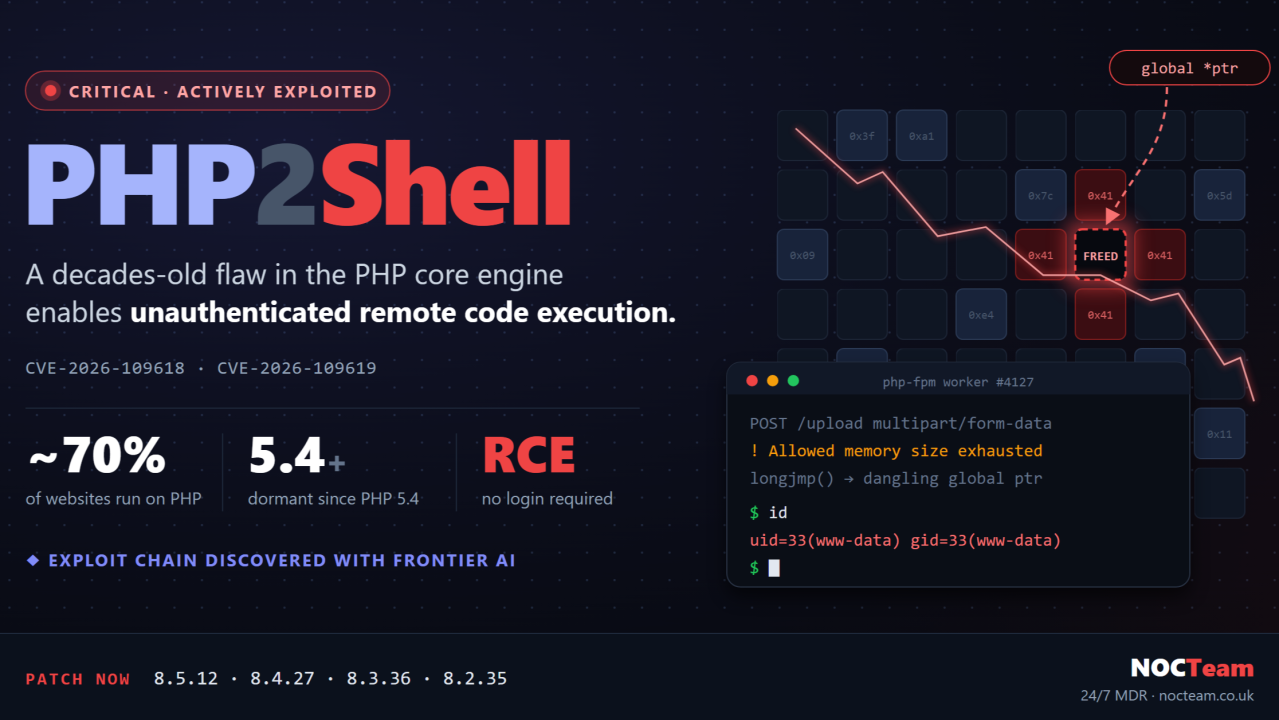
On October 21, 2026, the security world was rocked by emergency updates issued for core PHP. Dubbed "PHP2Shell", two maximum-severity Remote Code Execution (RCE) flaws tracked as CVE-2026-109618 and CVE-2026-109619 have put millions of web applications at immediate risk, regardless of the underlying software or CMS.
If your enterprise runs WordPress, Drupal, Joomla, or custom web infrastructure built on PHP, here is what happened, how it came about, and why immediate action is required.
How the Vulnerabilities Came About
Unlike typical application-level bugs, PHP2Shell exists directly inside the core PHP engine. The underlying flaws have sat dormant in PHP's codebase for decades, stretching back as far as PHP 5.4.
- The Root Cause (Core Engine Memory Safety) - The vulnerabilities stem from how the PHP core handles out-of-memory (OOM) fatal errors and global variable state management during complex upload requests. When a fatal allocation failure occurs, PHP aborts execution using longjmp(). This leaves global memory pointers referencing freed request memory creating a severe Use-After-Free (UAF) condition on subsequent requests handled by the same worker process.
- The AI Breakthrough - While human researchers knew these memory-safety primitives existed, constructing a reliable, unauthenticated exploit chain across different application environments was previously deemed too complex for human research constraints. Security researchers leveraged frontier AI models to systematically analyze the state-machine edge cases, chaining memory disclosure with state corruption to achieve unauthenticated Remote Code Execution.
- Exploitation Ahead of Coordinated Patching - Technical details leaked ahead of the coordinated release schedule on October 20, driving immediate active exploitation attempts against unpatched web hosts worldwide.
Why PHP2Shell Is Uniquely Dangerous
- Bypasses Application Logic - Because the flaw operates at the interpreter level, Web Application Firewalls (WAFs) and standard application-level security plugins cannot catch every variant without deep engine inspection.
- Universal Reach - PHP powers roughly 70% of all websites globally. Every major version released over the last decade (8.2, 8.3, 8.4, and 8.5) requires immediate core patches.
- Silent Execution - Application logs will often show nothing more than routine HTTP multipart requests followed by worker memory limit crashes (HTTP 500 responses).
Actionable Remediation Checklist
- Update Core PHP Engine - Immediately apply emergency releases 8.5.12, 8.4.27, 8.3.36, or 8.2.35 across all production and staging environments.
- Audit End-of-Life Versions - PHP 8.1 and older versions do not receive official updates from the PHP Project. Check with your Linux distribution/LTS vendor for backported packages or isolate legacy servers.
- Monitor Worker Anomalies - Look for abnormal worker process churn, sudden spikes in memory limit error logs, or unusually large request payloads targeting session handling endpoints.
Need Emergency Assistance with Infrastructure Hardening?
Struggling to track vulnerabilities across your enterprise stack? NOCTeam provides 24/7 Managed Detection & Response (MDR), server infrastructure monitoring, and rapid patch deployment to keep your systems resilient against emerging threats.
Email [email protected] today for a free health check of your environment.
#CyberSecurity #PHP2Shell #Infosec #PatchManagement #NOCTeam #ThreatIntel #WebSecurity #VulnerabilityManagement #WordPress #EnterpriseIT
Originally published on LinkedIn.