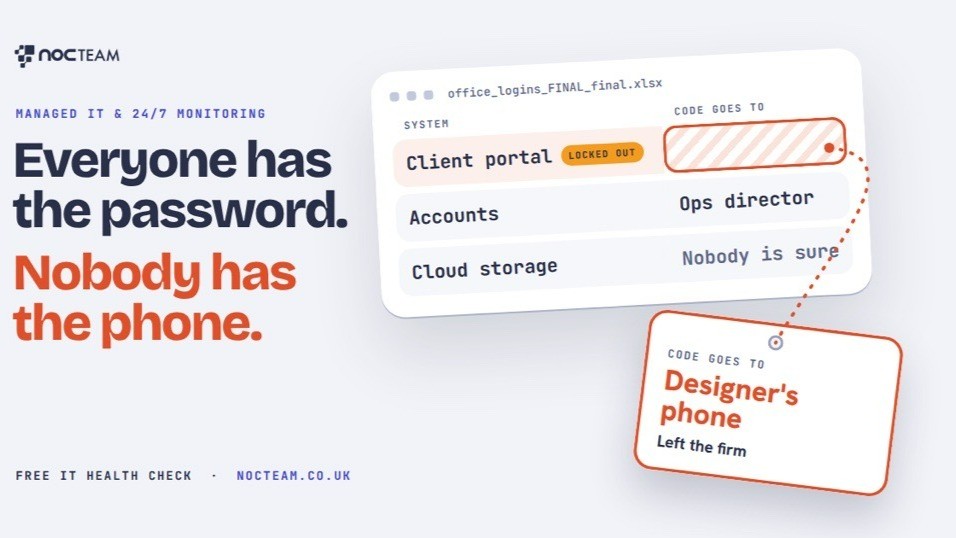
Karen, the operations director of a specialist marketing consultancy in Manchester, sits down at her desk on a quiet Friday afternoon to upload a major brand strategy campaign to a client publishing portal ahead of a strict weekend launch. When she enters the master username and password recorded on a shared internal spreadsheet, the system screen prompts her for a secondary verification code sent via text message. After waiting several minutes without receiving a code, she asks around the open-plan office, only to discover that the registered telephone number belongs to a senior graphic designer who left the firm recently to join a commercial competitor. With the former colleague unreachable, the entire account-handling team finds itself completely locked out of the portal, leaving a valuable corporate client waiting in vain for an urgent campaign release while fee-earning staff scramble to find a workaround.
This frustrating operational bottleneck stems from a remarkably common shortcut known as credential sharing. When a growing firm adopts new web applications, industry software, or client submission portals, setting up individual user accounts for every single employee often feels like an unnecessary administrative chore. To save time during onboarding and avoid additional software licensing costs, leadership teams routinely create a single master login and distribute the password across the office floor. What begins as an innocent convenience quickly hardens into accepted operational practice, creating a fragile environment where essential business systems rely upon unmanaged, informal arrangements rather than clear individual responsibility. As the business expands, this habit quietly creeps into core financial portals, shared cloud storage, and vendor accounts. Busy staff members focus entirely on meeting client deadlines, assuming someone else in management is maintaining oversight of the underlying access permissions.
The practical commercial risk of this informal approach extends far beyond a delayed campaign submission or a ruined Friday evening. Relying on shared logins completely obscures individual accountability across your workforce. When multiple employees access corporate systems using the exact same credentials, it becomes impossible to establish who modified a critical file, altered an underlying setting, or downloaded sensitive records. More critically, when a staff member moves on to a new role, changing a shared password requires updating every single colleague who relies on that account, a tedious administrative task that is frequently forgotten amidst the daily rush of billable work. This oversight leaves former staff members with lingering access to proprietary client records long after they have handed back their office keys, exposing your practice to severe compliance oversights and damaging hard-won commercial relationships when sensitive files are unexpectedly compromised.
Eliminating this structural vulnerability requires moving away from informal shared workarounds and establishing proper access management across all business software. A resilient operational posture relies on providing every employee with their own distinct login credentials while enforcing strict security rules behind the scenes. Maintaining this structured environment depends on continuous infrastructure observation rather than sporadic internal audits. While automated monitoring systems maintain a constant watch over user accounts to detect irregular login attempts or unexpected permission changes, dedicated technical engineers investigate and resolve these operational alerts during agreed hours, or around the clock where a client has contracted for it. This disciplined oversight ensures user permissions remain properly aligned and departing staff have their system access revoked immediately, keeping your fee-earning team focused on client delivery rather than technical troubleshooting.
This level of calm, structured oversight is precisely what NOCTeam provides for growing professional services firms, ensuring your operational environment remains secure, predictable, and fully aligned with your commercial standards. Bringing genuine clarity to your user access management removes the quiet background anxiety of unowned permissions, allowing your executive leadership to focus entirely on long-term business growth.
Book your free IT Health Check by visiting nocteam.co.uk or by emailing us at [email protected].
#BusinessContinuity #ITSupport #ManagedIT #ProfessionalServices #VirtualITManager
Originally published on LinkedIn.