In today's fast-paced business environment, employees often use the fastest tool available to get the job done. This ease of access to cloud applications (SaaS) and file-sharing services, while boosting productivity, has led to an explosion of Shadow IT—technology systems used within an organization without explicit IT approval or oversight.
For Business Leaders and IT Management, Shadow IT is no longer a nuisance; it is a massive governance and security risk that can lead to data leakage, compliance fines, and critical security gaps.
What is Shadow IT?
Shadow IT refers to any hardware or software purchased, installed, or operated by employees or departments without the knowledge, approval, or centralized control of the IT department.
Common Examples of Shadow IT:
- File Sharing: Employees using personal Dropbox, Google Drive, or WeTransfer accounts to share corporate documents.
- Collaboration: Departments setting up unsanctioned project management tools (like Trello or Asana) or communication apps (like Slack/Discord workspaces).
- Development: Engineers spinning up virtual machines or databases in personal cloud accounts (AWS/Azure).
Latest Shadow IT Statistics:
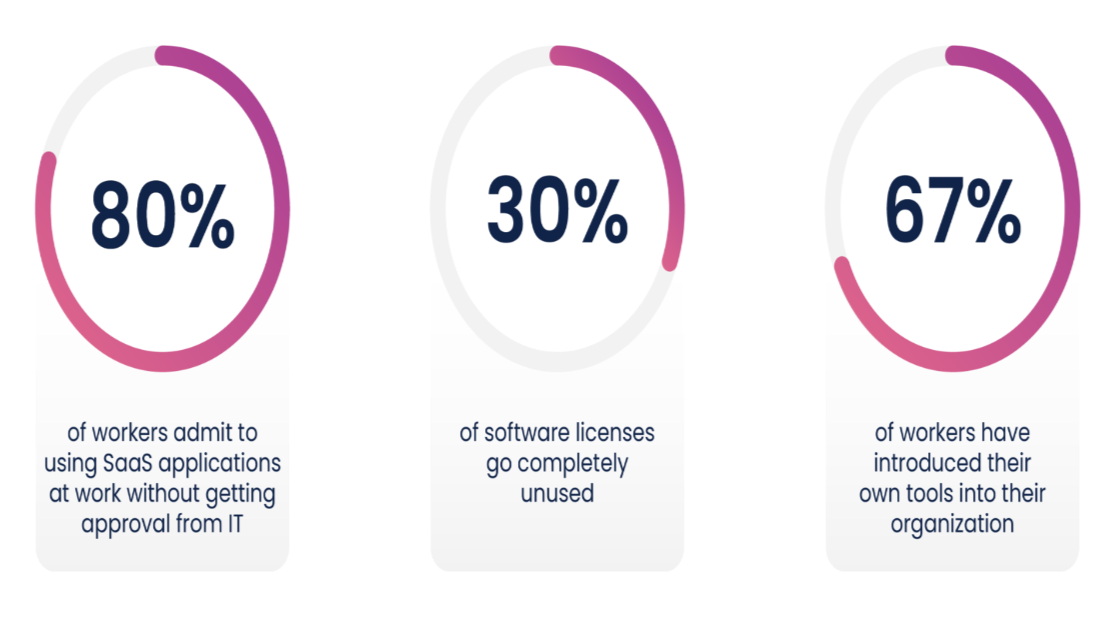
- 80% of workers admit to using SaaS applications without getting IT approval.
- Shadow IT cloud usages estimated to be 10x the size of known cloud usage.
- The average company have 975 unknown cloud services.
- Most companies have over 108 known cloud services.
- 37% of IT leaders say security policies are the biggest challenge to an effective employee digital experience.
- Shadow IT accounts for 30-40% of IT spending in large enterprises.
- 82% of IT leaders say users push back when management tried to dictate which tools should be used.
- 67% of workers have introduced their own tools into their organization.
- 1 out of 3 employees at Fortune 1000 companies use cloud services that IT hasn’t approved.
- 53% of teams refuse to only use IT-approved tools.
Source - Uniqkey
The Four Major Risks of Unmanaged Cloud Access
The primary danger of Shadow IT is that it creates invisible, unsecured exit routes for corporate data.
1. Data Leakage and Loss
When employees upload sensitive data (customer lists, intellectual property) to unmanaged personal cloud accounts, the data is completely outside the corporate security perimeter. If the employee leaves the company, that data often remains in their private cloud account, creating a significant data leakage and retention risk.
2. Compliance and Regulatory Violation
The UK GDPR mandates control over where and how personal data is processed. Unsanctioned SaaS tools, particularly those hosted outside the EU or lacking proper security controls, instantly put your organization at risk of regulatory non-compliance and substantial fines.
3. Security Vulnerabilities
Unapproved applications rarely meet corporate security standards. They may lack Multi-Factor Authentication (MFA), contain unpatched vulnerabilities, or be configured with weak passwords, providing an easy back door for attackers to gain a foothold in the organization.
4. Cost and Efficiency Drain
The proliferation of dozens of different, often overlapping, SaaS subscriptions leads to inflated IT spending and management complexity that the business may not even realize it has.
Bringing the Shadows into the Light: The Solution
Combating Shadow IT requires a cultural and technological shift focused on visibility and governance:
- Gain Visibility: Use Cloud Access Security Broker (CASB) tools or enhanced monitoring within Microsoft 365 to track which cloud services employees are using and the volume of data flowing to them.
- Establish Clear Policies: Create a transparent process for employees to request and approve new SaaS tools quickly. This turns "Shadow IT" into "Approved IT."
- Consolidate and Integrate: Drive users toward approved, enterprise-grade platforms (like managed M365 environments) that offer the functionality they need securely and are governed by IT.
Master Your Cloud Governance with NOCTeam
Don't let invisible cloud services put your business at risk. NOCTeam provides the expertise needed to manage and secure your entire cloud landscape.
- Cloud Security Assessment: We audit your environment to uncover all unsanctioned applications, identify compliance gaps, and map out where sensitive data resides outside of your control.
- M365 Governance and DLP: We configure advanced Microsoft 365 features, including Data Loss Prevention (DLP) and CASB capabilities, to automatically restrict data from moving to unapproved cloud services.
- Access Control and Lifecycle Management: We help you implement standardized, secure provisioning and de-provisioning processes for all SaaS accounts, ensuring former employees never take corporate data with them.
Are you ready to stop managing a hidden attack surface?
Contact NOCTeam today at [email protected] for a free IT systems assessment to get your company on a path to a better cloud posture.
#ShadowIT #CloudGovernance #SaaS #DataLeakage #NOCTeam
Originally published on LinkedIn.