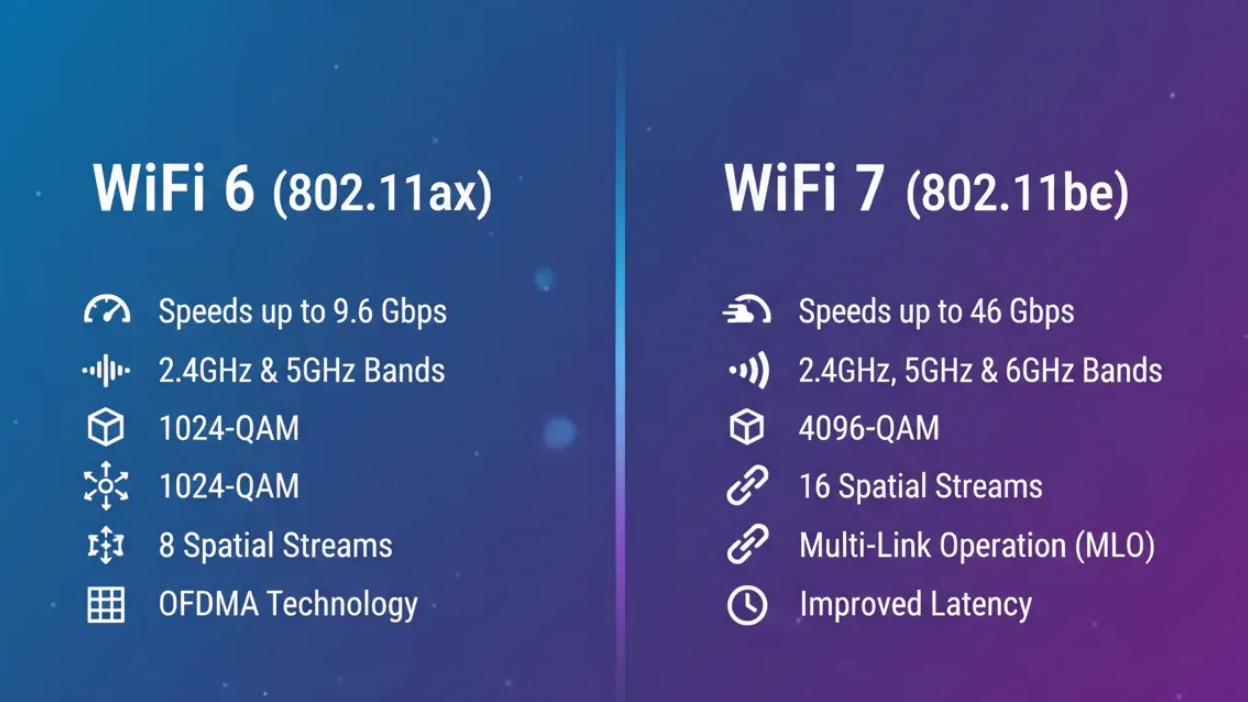
For years, the gold standard for IT networking was throughput. We chased "Gigabit speeds" like they were the only metric that mattered. But as we move through the first half of 2026, the conversation has fundamentally shifted.
The latest market data from Dell’Oro Group confirms it, Wi-Fi 7 (802.11be) is no longer a "niche upgrade." It has become the default enterprise refresh.
1. The Death of the "Wait and See" Strategy
Unlike the transition to Wi-Fi 6E, which many organizations skipped due to limited client support for the 6GHz band, the Wi-Fi 7 wave is absolute. Hardware prices have hit an unexpected low this quarter, making the cost-to-performance ratio for a Wi-Fi 7 access point (AP) nearly identical to legacy Wi-Fi 6 hardware.
2. It’s Not Speed—It’s "Deterministic" Latency
The "happening" here isn't just the speed (which hits a theoretical 46 Gbps). It’s Multi-Link Operation (MLO).
- The Old Way - Your device connects to either 2.4GHz, 5GHz, or 6GHz. If that band gets congested, you lag.
- The 2026 Way - Wi-Fi 7 devices can now use multiple bands simultaneously. They can send and receive data across 5GHz and 6GHz at the same time.
For IT Support teams, this means a massive reduction in "my Zoom is lagging" tickets. We are moving from "best-effort" wireless to "deterministic" wireless that rivals wired Ethernet for stability.
3. The 6GHz "Clean Spectrum" Revolution
With the FCC and global regulators (including recent pilot frameworks in regions like Vietnam and Southeast Asia) opening up the standard-power 6GHz band via Automated Frequency Coordination (AFC), we are finally seeing "clean" airwaves. 2026 is the year we stop fighting for space on the crowded 2.4GHz band and move business-critical operations to a dedicated, interference-free lane.
What IT Leaders Need to Audit Today
- Power Budgets (PoE++) - Most Wi-Fi 7 APs require PoE++ (802.3bt) to run all radios at full capacity. If you aren't upgrading your switches alongside your APs, you’ll be running in "crippled mode."
- The "Legacy SSID" Quarantine - 2026 is the year to officially move WPA2-only devices to a separate, isolated VLAN. WPA3 is now the mandatory baseline for 6GHz operations.
- Backhaul Bottlenecks - There is no point in a Multi-Gigabit Wi-Fi 7 radio if your uplink is still a 1Gbps copper cable. 2.5GbE and 5GbE at the edge are now the 2026 standard.
Is your campus or office ready for the 6GHz era? At NOCTeam, we specialize in "future-proofing" infrastructure. From Wi-Fi 7 RF surveys to 10GbE backhaul upgrades, we ensure your network is ready for the high-density, low-latency demands of tomorrow.
#WiFi7 #Networking #ITInfrastructure #EnterpriseIT #TechTrends2026 #NetworkEngineering #6GHz
Originally published on LinkedIn.